Handmade Terracotta Planters
September 5, 2026
How the Natural Micro-Porous Structure of Terracotta Helps Create a Better Environment for Plants
A garden pot is more than a container. It becomes part of the environment in which a plant grows, and the material from which that pot is made can influence moisture, aeration, temperature, and the overall condition of the growing medium.
Among the many materials available today, fired terracotta remains one of the most naturally suited materials for traditional plant cultivation.
Its secret lies in its structure.
When natural clay is shaped and carefully fired, it develops a network of microscopic pores within the ceramic body. These tiny spaces give terracotta its characteristic micro-porous nature, allowing limited movement of air and moisture through the walls of the pot.
This natural breathability is one of the reasons terracotta has remained a trusted choice for gardeners for generations.
What Makes Terracotta Porous?
Terracotta begins with natural clay.
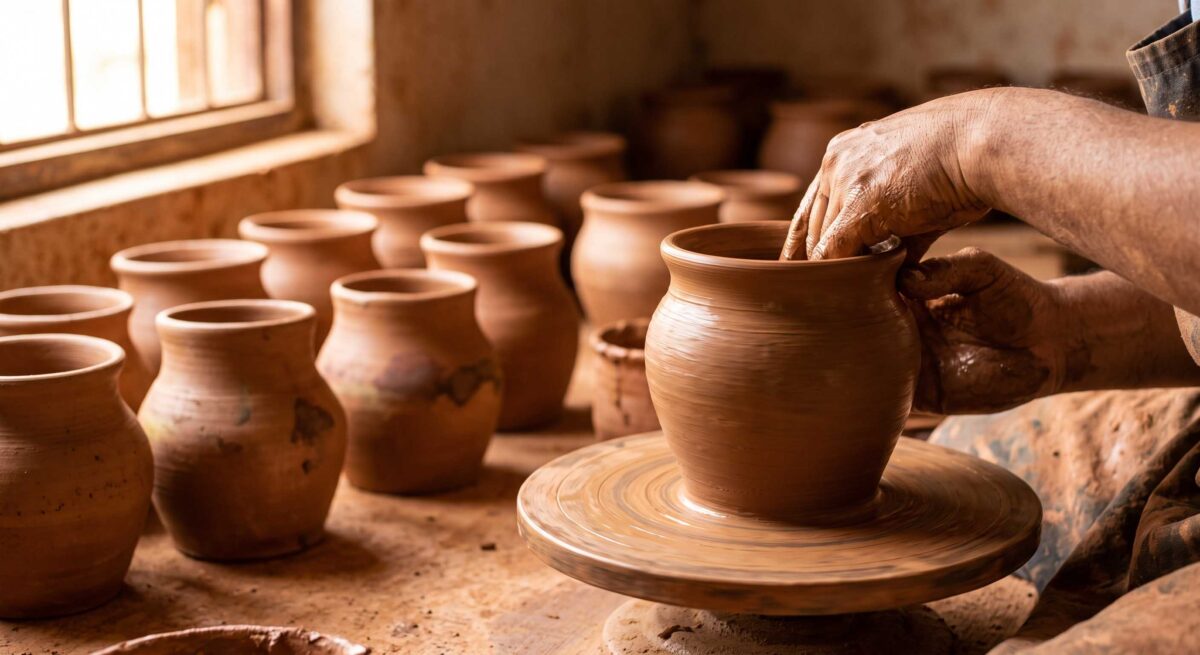
The clay is prepared, shaped into pots and planters, dried, and then fired in a kiln. During firing, water and organic components are driven out and the clay particles bond together. Depending on the clay composition and firing conditions, the finished terracotta retains a network of very small pores.
Unlike fully vitrified ceramics, which are fired to become highly dense and relatively impermeable, traditional terracotta is generally fired to retain a degree of natural porosity.
These pores are not large holes that allow water to freely pass through. Instead, they form a fine network within the clay body.
This micro-porous structure is what gives traditional terracotta its distinctive ability to interact with moisture and air.
Plants Need More Than Water
When we think about caring for plants, watering is often the first thing that comes to mind.
But healthy roots need more than water.
They also need access to oxygen.
Plant roots carry out respiration, a process that requires oxygen. A growing medium that remains excessively saturated for long periods can contain less available oxygen around the roots. For many plants, particularly those sensitive to waterlogging, maintaining a healthy balance between moisture and air in the root zone is important.
This is where the natural characteristics of terracotta can be valuable.
Because terracotta is porous, moisture can gradually move toward the outer surface of the pot and evaporate. At the same time, the pot wall allows some exchange of air and water vapour.
The result is a growing environment that can encourage better aeration and more balanced moisture conditions, depending on the plant, soil, climate, and watering practices.
Plants “Breathe” Through Their Roots
The phrase “plants breathe” is often used to describe the need for healthy root aeration.
Plants exchange gases primarily through their leaves, but their roots also require oxygen for respiration. Healthy roots need an environment where water and air are appropriately balanced.
A terracotta pot does not literally supply oxygen directly to the roots in the same way that leaves exchange gases with the atmosphere. Rather, its porous walls can contribute to the movement of air and moisture around the growing medium.
This is particularly relevant when compared with completely impermeable containers.
The natural interaction between terracotta, soil, moisture, and surrounding air is one of the reasons gardeners have valued clay pots for centuries.
Natural Moisture Regulation
One of the most recognizable characteristics of an unglazed terracotta pot is that the outside of the pot can sometimes feel cool or slightly damp after watering.
This occurs because moisture within the growing medium can migrate through the porous clay wall and evaporate from the outer surface.
This process, often described as evaporative cooling, can contribute to the cooling of the pot and its contents. The degree of this effect varies considerably with humidity, temperature, airflow, pot thickness, soil composition, plant type, and watering frequency.
In warm and dry environments, the effect can be more noticeable.
For gardeners, this also means that terracotta pots can dry out faster than non-porous containers. That is an advantage for some plants and growing conditions, but it also means watering practices may need to be adjusted.
Good gardening is always about finding the right balance.
A Natural Choice for Plants That Prefer Good Drainage
Terracotta is particularly popular for plants that benefit from relatively well-drained growing conditions.
Mediterranean plants, herbs, succulents, cacti and many other plants can perform well in terracotta when paired with an appropriate growing medium and watering routine.
The porous nature of the pot can help prevent the growing medium from remaining saturated for extended periods.
However, terracotta is not a universal solution for every plant.
Plants that prefer consistently moist soil may require more frequent watering when grown in unglazed terracotta. Gardeners should therefore select the pot material according to the plant’s requirements rather than assuming one material is best for everything.
That is precisely what makes terracotta interesting: it works with the natural needs of many plants rather than trying to isolate the plant from its environment.
Terracotta and Root Health
Healthy roots are the foundation of healthy plants.
A good growing environment provides roots with access to water, nutrients and oxygen while allowing excess water to drain away.
Unglazed terracotta can contribute to this balance by allowing some moisture movement through the pot wall.
Its porous nature can be particularly useful for gardeners who tend to overwater or for plants that are sensitive to excessive moisture. At the same time, the pot’s ability to lose moisture means gardeners in very hot or dry climates may need to monitor their plants more carefully.
The goal is not simply to keep soil wet.
The goal is to create the right moisture–air balance.
The Difference Between Unglazed and Glazed Terracotta
Not all terracotta behaves in exactly the same way.
Traditional unglazed terracotta retains its natural porous surface and therefore provides the strongest expression of the material’s breathable character.
Glazed terracotta, on the other hand, has a glass-like coating applied to part or all of the surface. The glaze can add colour, decoration, water resistance and a different visual character, but it can also reduce or largely eliminate moisture exchange through the glazed area.
This gives gardeners and designers different choices.
Unglazed terracotta offers the traditional natural appearance and porous characteristics, while glazed finishes can provide additional decorative possibilities.
Both have their place.
Why Gardeners Still Choose Terracotta
Garden trends have changed dramatically.
Today, pots are available in plastic, fiberglass, concrete, metal, stone, composite materials, glazed ceramics and many other finishes.
Yet terracotta continues to be a favourite.
Part of its appeal is functional.
Part is aesthetic.
And part is emotional.
Terracotta looks natural because it comes from a natural material. Its warm earthy tones complement foliage and flowers. Its surface develops character with age. Mineral deposits and weathering can create a patina that makes an old pot look as though it has belonged in the garden for decades.
It does not look artificial.
It looks at home in nature.
From the Earth to the Garden
There is something deeply satisfying about the journey of a terracotta pot.
It begins as clay beneath the earth.
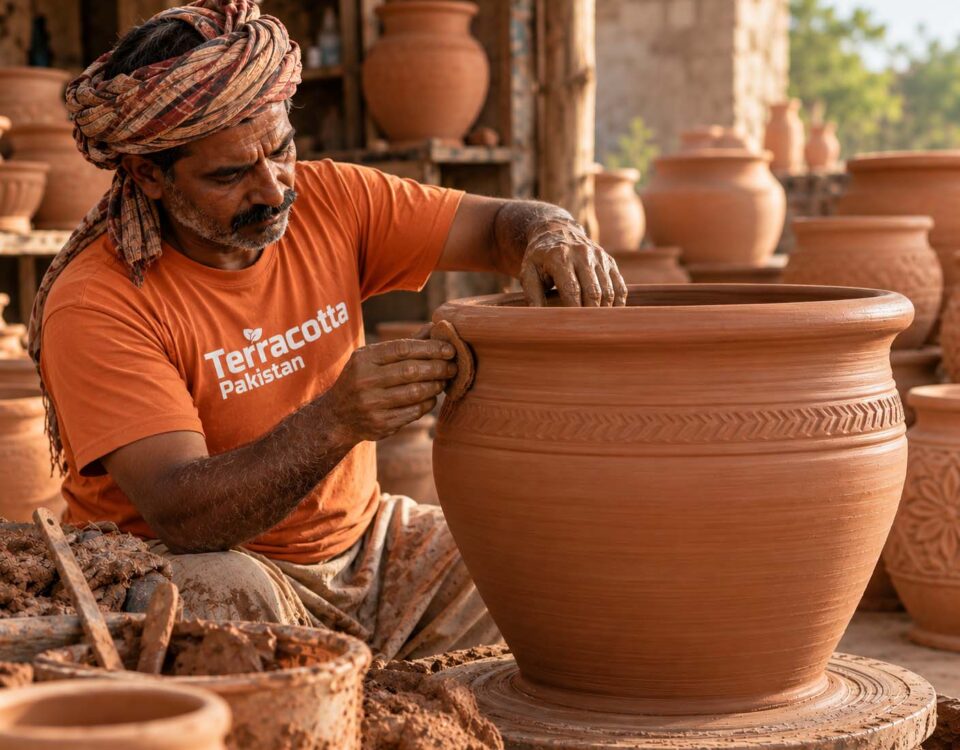
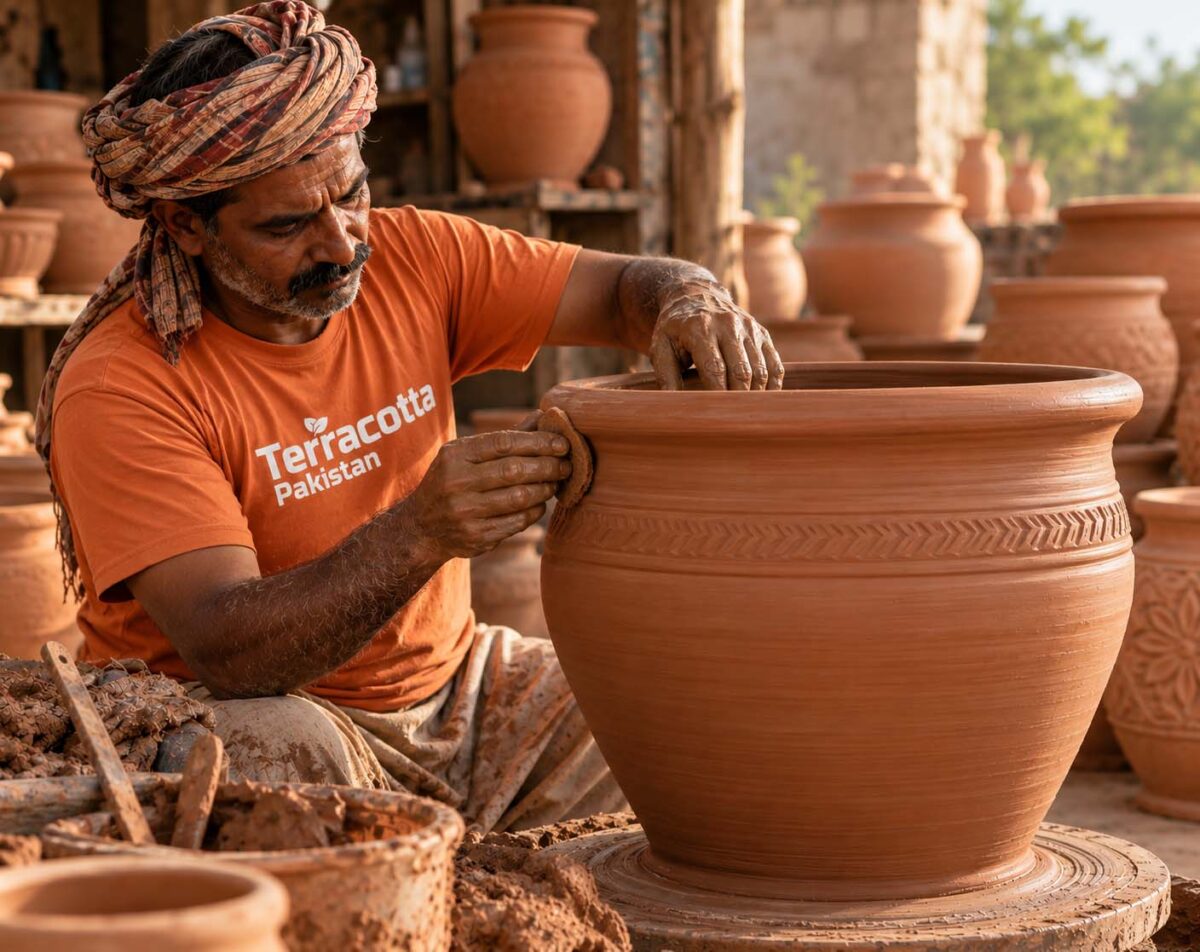
It is shaped by skilled hands.
It is transformed by fire.
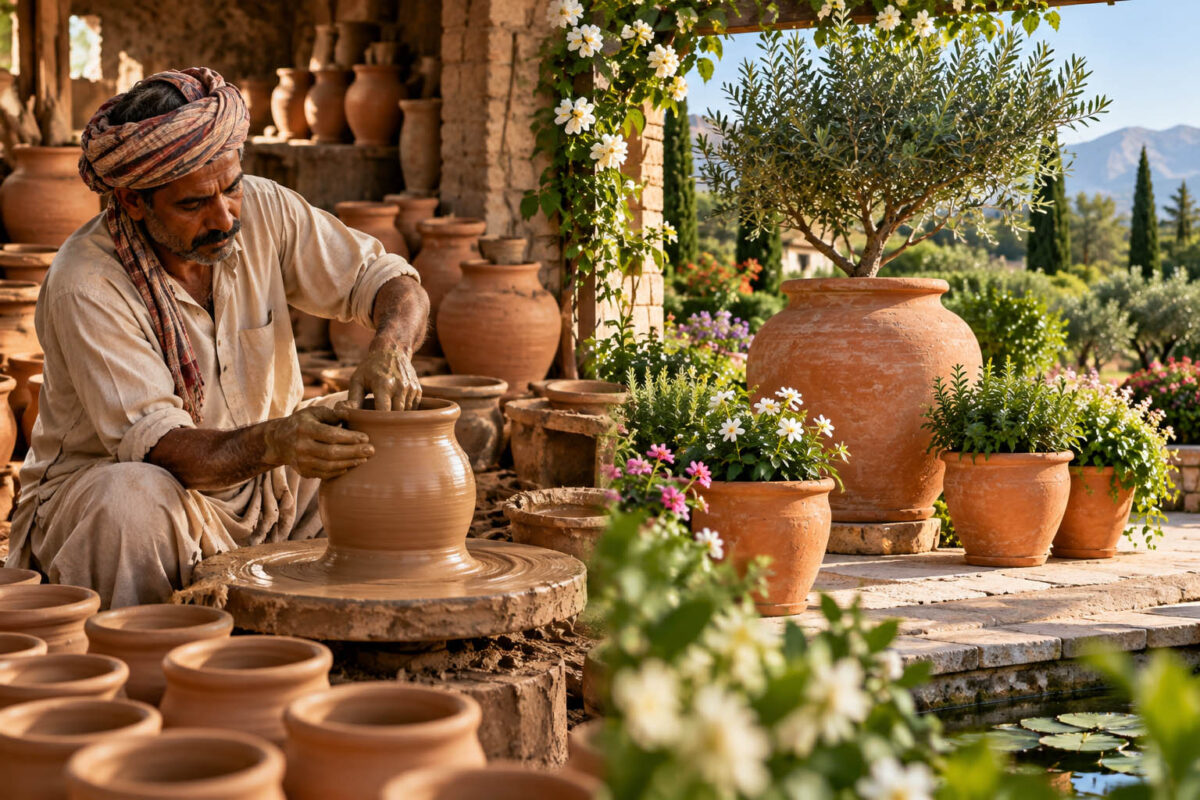
And eventually, it becomes part of a living garden.
This connection between earth, craftsmanship and plants is one of the reasons terracotta has survived for thousands of years as a material for pottery and gardening.
The pot itself becomes part of the story.
The Importance of Natural Clay
The quality and character of terracotta depend heavily on the clay from which it is made.
Natural clay is not simply a generic raw material. Its mineral composition, particle size, plasticity, impurities and firing characteristics can all influence the behaviour and appearance of the finished product.
Pakistan has a long and distinguished tradition of clay craftsmanship, supported by its rich geological and riverine landscapes.
The Indus River system, one of the world’s great river systems, has shaped the plains of Pakistan for thousands of years and deposited enormous quantities of sediment across the region. These clay-rich landscapes have supported traditional pottery communities and clay-based craftsmanship for generations.
For Pakistani terracotta producers, understanding and responsibly working with these natural clay resources is an important part of producing authentic terracotta.
Preserving Traditional Knowledge Through Modern Production
Terracotta is an ancient material, but its future does not have to be old-fashioned.
Traditional knowledge and modern manufacturing can work together.
Experienced craftsmen understand the behaviour of clay through years of hands-on experience. Modern production methods can provide consistency, quality control, improved efficiency and the ability to serve international markets.
The combination allows traditional terracotta to reach a much wider audience without losing its connection to its origins.
This is an important part of the philosophy behind Terracotta Pakistan.
Terracotta Pakistan: Natural Breathable Pottery for Gardens Around the World
Terracotta Pakistan is committed to taking Pakistani terracotta to gardens around the world.
Our focus is not simply on producing garden pots. It is on promoting a material, a tradition and the craftsmanship behind it.
By combining natural clay, skilled craftsmanship and modern production capabilities, Terracotta Pakistan supplies terracotta products to international markets while helping create greater visibility for Pakistani pottery and its makers.
We believe that the natural characteristics of terracotta deserve to be understood and appreciated.
Its micro-porous structure.
Its ability to interact with moisture.
Its natural earthy appearance.
Its traditional craftsmanship.
And its remarkable ability to sit naturally within gardens of almost every style.
From a small herb pot on an urban balcony to a large planter in an established landscape, terracotta continues to demonstrate why this ancient material remains relevant.
A Material That Works With Nature
Perhaps the greatest strength of terracotta is its simplicity.
It does not attempt to imitate nature.
It comes from nature.
Clay is shaped, fired and returned to the garden in the form of a vessel that supports living plants.
Its porous structure allows it to interact naturally with its surroundings. Its earthy surface complements plants rather than competing with them. And its traditional appearance gives gardens a sense of warmth, authenticity and permanence.
In a world increasingly filled with engineered materials, that natural connection matters.
The Breathable Choice
A good garden is a balance of many things: sunlight, water, soil, nutrients, temperature, airflow and care.
The right container can become an important part of that balance.
Fired terracotta, particularly when left unglazed, offers a naturally porous environment that can support moisture movement and aeration around the root zone. While it still requires appropriate watering and good drainage, its natural characteristics make it a valuable choice for many types of plants.
That is why, after centuries of use, gardeners continue to return to terracotta.
Natural clay. Natural breathability. Timeless gardening.
At Terracotta Pakistan, we are proud to carry this tradition forward — creating natural, breathable terracotta pottery for gardens around the world.